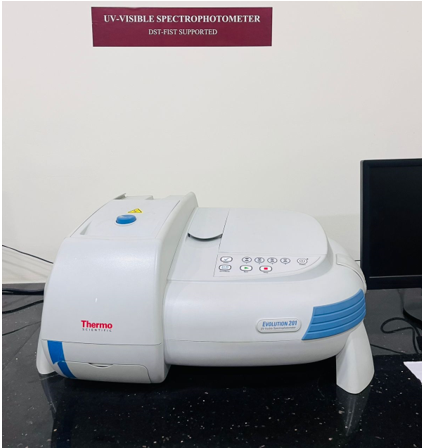
UV-Vis Spectrophotometer
The UV–Visible spectrophotometer shown is the Evolution 201 model from Thermo Fisher Scientific, widely used in chemical and biochemical laboratories for both quantitative and qualitative analysis of compounds. It operates based on UV–Visible Absorption Spectroscopy, where molecules absorb light in the ultraviolet (200–400 nm) and visible (400–800 nm) regions, with the absorbed energy corresponding to electronic transitions such as π→π* and n→π*. The instrument typically consists of a light source (deuterium lamp for the UV region and tungsten lamp for the visible region), a monochromator for wavelength selection, a sample holder or cuvette compartment for placing the solution, and a detector that measures transmitted light and converts it into absorbance. The front panel contains operational controls, while the sample compartment allows insertion of cuvettes containing sample and reference solutions. This spectrophotometer is commonly used for determining concentration using the Beer–Lambert law, monitoring reaction kinetics, studying electronic transitions in organic and inorganic compounds, analyzing metal–ligand complex formation, and measuring absorbance and transmittance spectra; it is a non-destructive, rapid, and highly sensitive analytical technique, making it indispensable for routine laboratory analysis and research applications.