


MES Kalladi College Programmes | UG, PG & Honours Courses in Kerala
MES COllege

Research

Inspiring Inquiry, Advancing Knowledge for Social Progress

Explore our research centres

Research Centres

Centre for Sustainable Chemical Research (CSCR)
View details
Centre for Commerce & Management Research (CCMR)
View details
Centre for Tribal Studies & Research (CTSR)
View details
Centre for Research in Higher Mathematics (CRHM)
View details
Centre for Research in Developmental Economics (CRDE)
View details
Sophisticated Instrumentation for Advanced Research

Research Facilities

Sophisticated Instrumentation Facility Centre

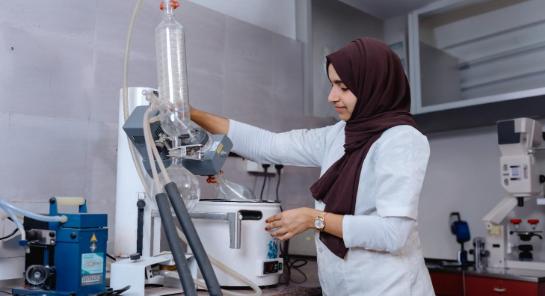
The Sophisticated Instrumentation Facility Centre provides advanced instruments and technical support to facilitate high-quality research, experimentation, and innovation for students and faculty.

View More

Research Laboratory

The Research Laboratory offers the infrastructure and resources needed to promote quality research and scientific exploration.

View More

DST–FIST Computer Lab

Established under the DST-FIST scheme, the lab offers high-performance computing resources to support research and technology-driven learning.

View More

Infra Red Spectrometer

The Infra Red Spectrometer helps identify chemical compounds by analyzing infrared absorption, aiding research and laboratory studies.

View More

FT-IR Spectrometer

The ATR FT-IR spectrometer manufactured by Shimadzu Corporation is a widely used analytical system for the rapid identification and characterization of chemical compounds. It operates on the principle of Fourier Transform Infrared Spectroscopy, which measures the absorption of infrared radiation by a sample at different wavelengths to provide information about its molecular structure and functional groups. The Attenuated Total Reflectance (ATR) accessory enables direct analysis of solid, liquid, or semi-solid samples without extensive preparation by placing the sample on an ATR crystal, where the IR beam undergoes internal reflection and interacts with the sample surface. Key components include the ATR crystal platform with a pressure clamp for proper sample contact, the main spectrometer unit housing the IR source, interferometer, and detector, and a computer system for instrument control, data acquisition, and spectral analysis. This instrument is extensively used in organic, inorganic, and materials chemistry for functional group identification, structural confirmation of synthesized compounds, reaction monitoring, and quality control, with the ATR-FTIR technique offering advantages such as rapid analysis, non-destructive measurement, minimal sample preparation, and highly reproducible spectra.

View More

UV-Vis Spectrophotometer

The UV–Visible spectrophotometer shown is the Evolution 201 model from Thermo Fisher Scientific, widely used in chemical and biochemical laboratories for both quantitative and qualitative analysis of compounds. It operates based on UV–Visible Absorption Spectroscopy, where molecules absorb light in the ultraviolet (200–400 nm) and visible (400–800 nm) regions, with the absorbed energy corresponding to electronic transitions such as π→π* and n→π*. The instrument typically consists of a light source (deuterium lamp for the UV region and tungsten lamp for the visible region), a monochromator for wavelength selection, a sample holder or cuvette compartment for placing the solution, and a detector that measures transmitted light and converts it into absorbance. The front panel contains operational controls, while the sample compartment allows insertion of cuvettes containing sample and reference solutions. This spectrophotometer is commonly used for determining concentration using the Beer–Lambert law, monitoring reaction kinetics, studying electronic transitions in organic and inorganic compounds, analyzing metal–ligand complex formation, and measuring absorbance and transmittance spectra; it is a non-destructive, rapid, and highly sensitive analytical technique, making it indispensable for routine laboratory analysis and research applications.

View More

Spectrofluorometer

The instrument shown is a spectrofluorometer, specifically the SL 174 model from ELICO Ltd., used for measuring fluorescence emitted by chemical substances. It operates on the principle of Fluorescence Spectroscopy, where a molecule absorbs light at a specific excitation wavelength and subsequently emits light at a longer wavelength, allowing the study of its electronic and structural properties. The instrument comprises a light source (typically a xenon lamp) for excitation, excitation and emission monochromators for wavelength selection, a sample holder or cuvette compartment, and a detector positioned at 90° to the incident beam to minimize scattered light and accurately measure fluorescence intensity, along with a digital display and control panel for operation and data acquisition. Due to its high sensitivity, it is widely used for detecting trace amounts of compounds, studying fluorescent molecules and probes, analyzing metal–ligand interactions, investigating biomolecules such as proteins and nucleic acids, and monitoring environmental pollutants. Compared to UV–Visible spectroscopy, fluorescence spectroscopy offers superior sensitivity and selectivity, making it particularly valuable for low-concentration analysis and advanced research in analytical chemistry, biochemistry, and materials science.

View More

RGB Laser

An RGB laser is a laser system that combines three primary laser beams—red, green, and blue—to generate a wide range of colors, including white light, by controlling the intensity of each component through additive color mixing. The typical laser sources include red (~630–650 nm), green (~520–532 nm), and blue (~445–470 nm), whose beams are combined using optical elements such as dichroic mirrors to produce a single aligned output. The working principle is based on Additive Color Mixing, where combinations like red + green produce yellow, red + blue produce magenta, blue + green produce cyan, and all three together produce white light. The output color can be precisely tuned by electronically adjusting the power of each laser source. RGB lasers are widely used in laser display systems and projectors, stage lighting and entertainment, optical experiments and spectroscopy, as well as in advanced imaging techniques such as confocal microscopy. They offer significant advantages including high brightness, excellent color purity, precise wavelength control, and rapid modulation capabilities, making them essential tools in modern optics for advanced visualization, imaging, and display technologies.

View More

High Resolution Spectrometer

The Marutek XM100 Tunable Light Source with Xenon lamp and monochromator is a high-resolution spectroscopic system designed for precise optical studies across the UV–Visible–NIR region, developed by Marutek. It operates on the principle of a tunable monochromatic light source, where a broadband xenon lamp emits intense continuous radiation that is passed through a monochromator to isolate specific wavelengths, enabling controlled spectral output for analytical applications. The system typically covers a wavelength range of about 240–800 nm with high wavelength accuracy (≤0.5 nm) and adjustable resolution depending on slit width, making it suitable for high-precision measurements. Key features include a 100 W ozone-free xenon lamp with high arc stability and long service life, interchangeable diffraction gratings, adjustable slits for bandwidth control, and built-in filters to eliminate higher-order harmonics. The instrument provides a stable, intense, and tunable beam that can be integrated with detectors or spectrometers for advanced analysis. It is widely used in absorption, fluorescence, and reflectance spectroscopy, material characterization, photophysical studies, and calibration of optical systems, offering advantages such as continuous wavelength tunability, high spectral purity, excellent intensity, and reliable performance in research and quality control applications.

View More

Nano Fiber Electrospinning Unit

The Nanofiber Electrospinning Unit, manufactured by Holmarc Opto-Mechatronics Ltd., is an advanced research instrument used for the fabrication of ultra-fine nanofibers from polymer solutions using the principle of Electrospinning. It operates by applying a high-voltage electric field to a polymer solution, leading to the formation of a charged jet known as the Taylor cone, which elongates and solidifies into nanofibers as the solvent evaporates, with the fibers subsequently collected on a grounded or rotating collector. The system consists of key components such as a high-voltage power supply (typically 0–30 kV), a syringe pump for controlled solution flow, a spinneret (needle or coaxial) for dispensing the solution, a collector system (stationary or rotating mandrel at 300–4000 rpm) for fiber deposition, a fume hood chamber for safe and controlled operation, and computer-controlled software for precise adjustment of parameters like voltage, flow rate, and spinning time. The instrument can produce fibers ranging from approximately 50 nm to several micrometers and supports a wide range of materials including polymers, proteins, carbon-based, and inorganic substances, with flexible configurations for horizontal or vertical spinning. It enables uniform fiber formation with controlled diameter and morphology and is widely applied in tissue engineering, drug delivery, filtration membranes, protective textiles, sensors, energy storage, nanocomposites, and advanced functional materials; its advantages include high precision, the ability to produce aligned, random, or core–shell fibers, user-friendly programmable operation, and suitability for both research and prototype-scale production.

View More
Guiding Research Excellence and Collaboration

Research and Development Cell

It works actively to build a strong research culture in the campus. It encourages both teachers and students to develop an interest in research and innovation. The council regularly organizes seminars, workshops, and research meets in different subject areas, helping everyone stay updated and share ideas.
It also supports faculty members by guiding them in their research activities and providing opportunities to present their work. The council acts as the nodal body for implementing the Kalladi College Research Grant for teachers, helping them carry out meaningful research. Through these efforts, the council contributes to improving the academic environment and promoting quality research in the college.
Expert Guidance for Quality Research

Research Guides

Sl. No. Name Department Research Centre
1 Dr. C.Rajesh Chemistry Research &PG Department of Chemistry,MES Kalladi College Mannarkkad - Autonomous
2 Dr Sreenivasan.K.P Chemistry Research &PG Department of Chemistry,MES Kalladi College Mannarkkad - Autonomous
3 Dr. MOHAMMED MUSTHAFA T.N Chemistry Research &PG Department of Chemistry,MES Kalladi College Mannarkkad - Autonomous
4 Dr. Sivadasan TP History Research &PG Department of History,MES Kalladi College Mannarkkad - Autonomous
5 Dr. Junais. P History Research &PG Department of History,MES Kalladi College Mannarkkad - Autonomous
6 Dr Juliya A. P Chemistry Research &PG Department of Chemistry,MES Kalladi College Mannarkkad - Autonomous
7 Dr. Sereena K Botany MES Asmabi College P.Vemballur, Kodungallur
8 Dr Girish K P Mathematics Government College Chittur Palakkad
9 Dr.Ranjini M C Mathematics Department of Mathematics, MES Mampad College
10 Dr. Muhammed Rafi P Commerce Centre of Commerce and Management Research, MES Kalladi College Mannarkkad - Autonomous
11 Dr. Yasmin CK Commerce Centre of Commerce and Management Research, MES Kalladi College Mannarkkad - Autonomous
Encouraging Young Minds to Publish and Share Knowledge

Journal Aspiring Researcher

Journal Aspiring Research 2024
View
Journal Aspiring Researcher 2025
View
Outcome of the Annual International Conference

MESKCON Proceedings

MESKCON Proceedings 2024
View
MESKCON Proceedings 2025
View
Ethical Guidelines that Promote Responsible Research

Code of Ethics

For promoting productivity and intellectual output and honesty in academic writing, MES Kalladi College has taken immense number of measures for maintaining ethical practices in research activities. The guidelines of the procedures has to be abide by the students and teachers for their excellence in research by the following :

All research and academic works of the students such as assignment, project reports, dissertations should be free from plagiarism.

Students shall give an undertaking that their project/ dissertation/ assignment submitted for assessment is bonafide and has not been published anywhere for any other degree

Using mobile phones within the campus.

Organizing cinematic dance, DJ events, fashion shows, or birthday parties on campus.

Expert Support for Industry 

Consultancy

It reflect the institution’s commitment to extending its academic expertise beyond the classroom. The college encourages faculty members to offer their knowledge and skills as consultancy services to society, industry, and other institutions.
Through consultancy activities, the college provides expert guidance in various academic and professional areas, helping to address real-world challenges. These services not only strengthen the connection between the institution and the community but also create opportunities for faculty and students to gain practical exposure.
The consultancy initiatives contribute to knowledge sharing, skill development, and innovation, while also enhancing the reputation of the college as a center of excellence and social responsibility.