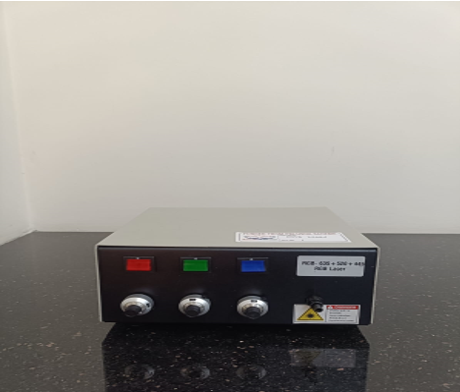
RGB Laser
An RGB laser is a laser system that combines three primary laser beams—red, green, and blue—to generate a wide range of colors, including white light, by controlling the intensity of each component through additive color mixing. The typical laser sources include red (~630–650 nm), green (~520–532 nm), and blue (~445–470 nm), whose beams are combined using optical elements such as dichroic mirrors to produce a single aligned output. The working principle is based on Additive Color Mixing, where combinations like red + green produce yellow, red + blue produce magenta, blue + green produce cyan, and all three together produce white light. The output color can be precisely tuned by electronically adjusting the power of each laser source. RGB lasers are widely used in laser display systems and projectors, stage lighting and entertainment, optical experiments and spectroscopy, as well as in advanced imaging techniques such as confocal microscopy. They offer significant advantages including high brightness, excellent color purity, precise wavelength control, and rapid modulation capabilities, making them essential tools in modern optics for advanced visualization, imaging, and display technologies.